
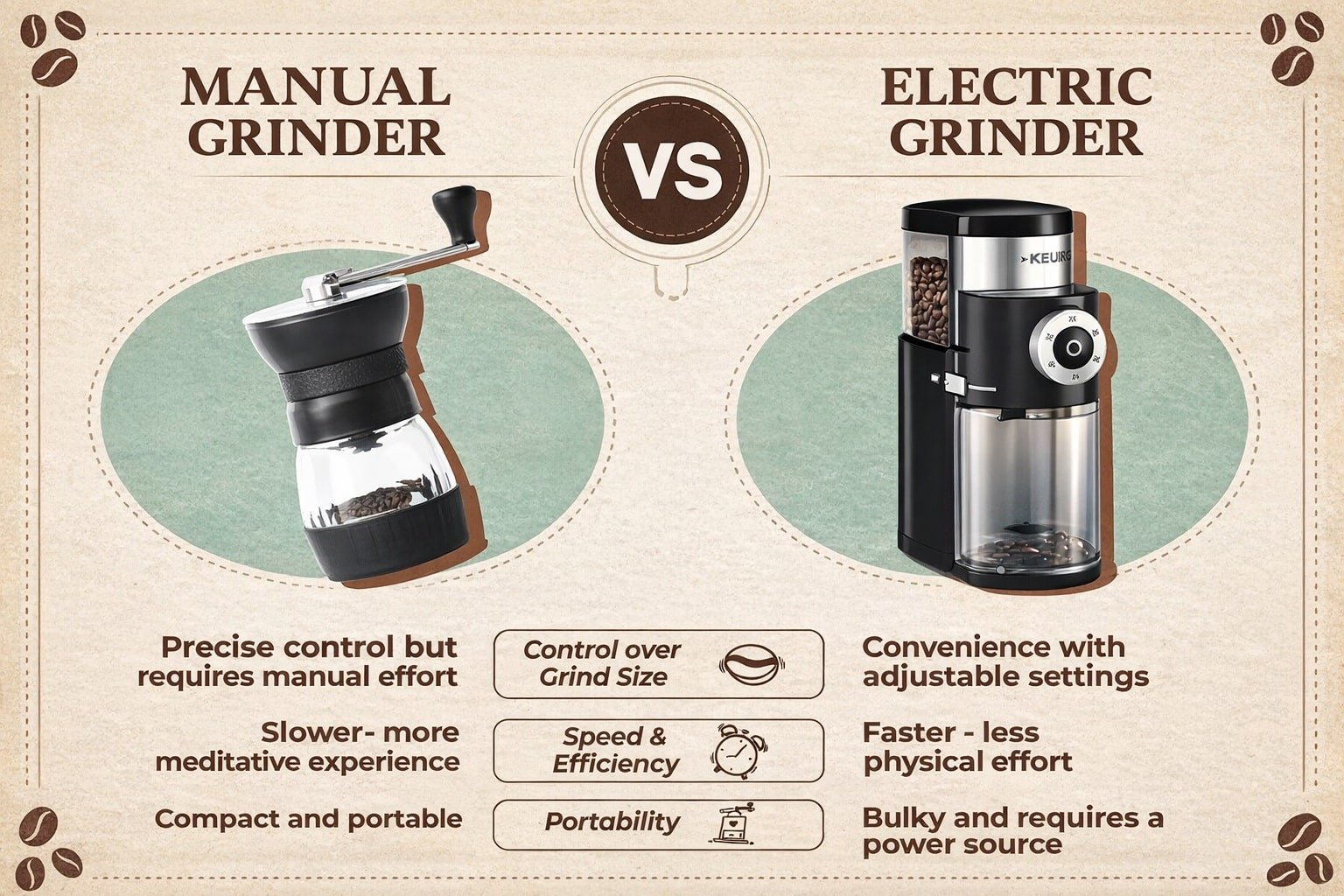
Manual vs electric coffee grinder: pick speed or control based on your taste.
You wake up craving a rich cup. You hear the quiet hum of an electric grinder in your head, then the calm rhythm of a hand-crank. You want fresh grounds, but you also want a routine that fits your mornings. The right grinder sets the tone for your day.
It shapes flavor, saves time, and matches your brew. This guide breaks down manual vs electric coffee grinder choices with real-world tips. I focus on control, speed, noise, and value. Then I share hands-on notes about top manual models you can buy today.

Mini Manual Coffee Grinder with…
40 EXTERNAL ADJUSTABLE GRIND SETTINGS – Unlike traditional grinders with internal adjustments, our manual coffee grinder offers 40 precise external settings. The easy-to-use adjustment ring lets you select your perfect…

CIRCLE JOY Manual Coffee Grinder…
40 External Grind Settings: Features 40 easy-access external settings for precise control, from extra-fine espresso to coarse French press. This manual coffee grinder works smoothly with all brewing methods Stainless…

Rsoilch Manual Coffee Grinder With…
Enjoy freshly ground coffee anytime with our versatile manual coffee grinder featuring 40 adjustable grind settings. The conical ceramic burr ensures a uniform grind for a perfect brew every time,…
Mini Manual Grinder, 40 Settings, 30g

This compact hand grinder brings 40 stepped settings in a palm-size frame. The 30g capacity suits one large mug or two small pour-overs. Conical burrs help deliver a more even grind than cheap blade grinders. If you like dialing in flavor without waking the house, this quiet tool fits the bill.
In daily use, the metal body feels sturdy, and the crank turns with a smooth glide. It shines for pour-over, AeroPress, and moka pot. Espresso is possible thanks to the wide range, but finer tuning takes patience. Compared to an electric model, it is slower, yet it gives you close control and a calmer morning flow.
Pros:
- 40 settings give wide grind range for many brew styles
- Quiet and travel-friendly for work or camping
- Conical burrs improve consistency over blade grinders
- Solid feel and easy hand-crank motion
- Low static and simple to clean
- Good value for new coffee hobbyists
- Small footprint for tight kitchens
Cons:
- 30g capacity limits batch size
- Manual grinding takes time and effort
- Fine espresso dialing can be slow
My Recommendation
If you want an entry manual grinder that still covers espresso to French press, this is a smart start. It fits anyone who values quiet grinding and tight control. If you compare manual vs electric coffee grinder trade-offs, this one wins on price, portability, and flavor focus. It loses to electrics on speed and batch size. For travel, this is an easy pick. For daily 1–2 cup mornings at home, it is a calm, capable partner.
| Best for | Why |
|---|---|
| Travel and office | Quiet, compact, and no power needed |
| Pour-over lovers | 40 settings help tune clarity and sweetness |
| Budget espresso | Fine settings possible without a big spend |
CIRCLE JOY Manual Grinder, 40 Settings
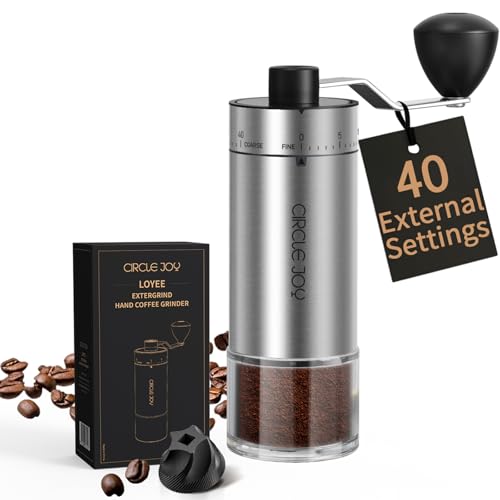
This grinder uses a ceramic conical burr set with an external adjustment ring. The dial makes it easy to see and repeat your setting. The stainless steel body looks clean on a counter and holds up to daily use. It is light enough for travel and sturdy enough for home.
Ceramic burrs resist heat and stay sharp for a long time. They also help keep flavors clear when you grind fine. With 40 steps, you can aim at espresso, pour-over, and French press. If you are used to electric speed, expect a slower pace, but also expect a more mindful cup.
Pros:
- External grind dial is fast and repeatable
- Ceramic burrs resist heat and wear
- Strong stainless housing with a sleek look
- Good control for pour-over and moka pot
- Compact and easy to pack for trips
- Low noise for early mornings
- Great price-to-performance ratio
Cons:
- Ceramic burrs can chip if mishandled
- Still slow for multiple cups
- Very fine espresso tuning takes effort
My Recommendation
This is ideal if you want a repeatable grind without guessing. The external dial saves time and makes consistency easy. When I stack up manual vs electric coffee grinder options, this model stands out as a travel-ready pick with a home-ready finish. It trades pure speed for control and taste. If you brew one to two cups and like clear flavor, this is a safe buy.
| Best for | Why |
|---|---|
| Dial-in learners | External settings are easy to track |
| Light espresso use | Ceramic burrs handle fine grinds |
| Minimalist kitchens | Clean look and small footprint |
Rsoilch Manual Grinder, 40 Settings

This Rsoilch manual grinder covers espresso to French press with 40 steps. It has a ceramic burr set designed for steady, repeatable output. The hand crank folds or detaches, which makes storage simple. It is a solid pick for people who want to try many brew methods.
I found the turn action smooth with light resistance at medium grinds. Fine settings take more work, as with most hand grinders. For drip and pour-over, the results are clean and even. If you stand between manual vs electric coffee grinder choices, this model makes a strong case for value and control.
Pros:
- Wide 40-step range for many brewing styles
- Smooth crank action at medium settings
- Detachable handle for easy packing
- Low grind retention for fresh taste
- Simple disassembly for cleaning
- Great entry option for hobby growth
Cons:
- Fine espresso grinds take time
- Less known brand may have fewer accessories
- Not ideal for big batches
My Recommendation
Choose this if you want a budget-friendly grinder that can grow with your skill. It hits a sweet spot for pour-over and moka pot, and it can try espresso when you are ready. In a manual vs electric coffee grinder match, this one leans toward control and price over speed. Good for students, small kitchens, and anyone brewing one or two cups.
| Best for | Why |
|---|---|
| Budget brewers | Strong performance without high cost |
| Pour-over fans | Consistent medium grinds with low fines |
| First espresso steps | Fine range possible when you want to try it |
60g Large Capacity Manual Grinder

With a 60g capacity, this manual grinder is built for larger brews. It pairs 40 adjustable settings with stainless steel burrs. That means better durability and strong bite at fine settings. It is a rare manual that can handle a 3–4 cup batch in one go.
In practice, larger capacity saves time for families or guests. Stainless steel burrs often feel faster than ceramic for the same size. The trade-off is weight and size. If you compare manual vs electric coffee grinder choices for batch brewing, this one narrows the gap.
Pros:
- 60g capacity suits 3–4 cups per grind
- Stainless steel burrs for durability and bite
- 40 settings across espresso to French press
- Faster grinding feel than many small hand mills
- Good for home use and small gatherings
- Build feels robust and long-lasting
Cons:
- Heavier and bulkier than pocket-sized models
- Costs more than ultra-budget hand grinders
- Less ideal for ultralight travel
My Recommendation
Pick this if you want a manual grinder for more than one cup. It is a strong bridge between hand-crank control and electric speed. In the manual vs electric coffee grinder debate, this stands out if you host friends but still like the quiet, hands-on grind. It makes sense for drip, Chemex, and even espresso when tuned right.
| Best for | Why |
|---|---|
| Families and hosts | 60g capacity cuts back-to-back grinding |
| Daily drip or Chemex | Even medium-coarse output at scale |
| Stainless burr seekers | Durable, efficient grinding feel |
EZLucky Manual Grinder, 5 Settings
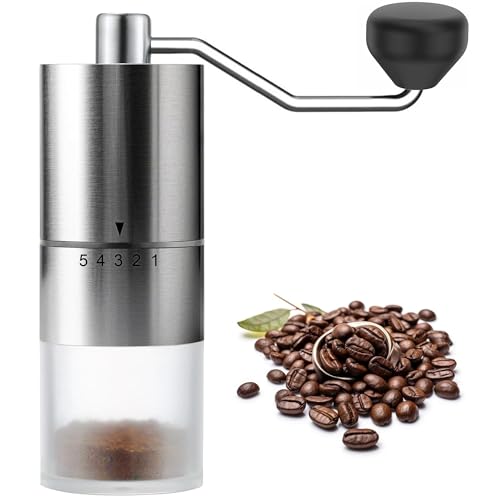
This EZLucky grinder keeps it simple with five stepped settings. The ceramic conical burrs are stable and consistent for daily use. It is compact, light, and easy to grip. If you want less fuss and quick choices, this is a friendly tool.
Five steps make sense for drip, pour-over, and French press. It can do moka pot as well. True espresso lovers may want more micro-steps to fine-tune shots. If you weigh manual vs electric coffee grinder convenience, this one wins on ease and price, not on micro-control.
Pros:
- Very easy to use and set
- Lightweight and portable
- Solid ceramic conical burrs
- Great for drip and French press
- Low price with decent grind quality
- Quick to clean and store
Cons:
- Only five settings limit fine-tuning
- Not ideal for dialing espresso shots
- Small capacity for batch brews
My Recommendation
Get this if you want a grab-and-go grinder that just works. It is perfect for simple daily mugs and weekend camping. When I look at manual vs electric coffee grinder options, this wins for minimalists and budget buyers. It is not for chasing café-level espresso, but it nails easy, clean brews.
| Best for | Why |
|---|---|
| Beginners | Five clear steps keep choices simple |
| Travelers | Light, compact, and durable |
| Drip coffee fans | Reliable medium grinds |
Jogcaw Manual Grinder, Multi Settings

The Jogcaw brings a multi-step ceramic burr system with a detachable crank. It aims at espresso, pour-over, and everything in between. The build is compact and easy to clean. It is a handy fit for a backpack or desk drawer.
For medium to medium-fine, it gives a steady grind with nice clarity in the cup. Coarser settings work well for French press too. As with most hand mills, fine espresso will take a little arm work and patience. If you compare manual vs electric coffee grinder options for quiet use, this one checks that box.
Pros:
- Multi-setting range covers common brew types
- Detachable crank for easy storage
- Quiet operation for early mornings
- Ceramic burrs for heat-resistant grinding
- Good control at pour-over settings
- Lightweight for travel and office
Cons:
- Fine espresso grinding takes effort
- Small hopper limits batch size
- Step markers may need trial and error
My Recommendation
Choose this if you want a quiet daily grinder with a broad range. It is ideal for pour-over people who sometimes brew French press. If manual vs electric coffee grinder speed concerns you, know this is slower but calmer. It is a practical pick for one or two cups and a tidy countertop.
| Best for | Why |
|---|---|
| Quiet mornings | Low noise, no outlet needed |
| Pour-over fans | Consistent medium-fine grinds |
| Small spaces | Compact and easy to store |
PARACITY Manual Grinder with 2 Jars

This PARACITY grinder pairs a ceramic burr mill with two 11oz glass jars. One jar can hold beans while the other stores grounds. That is a neat setup for home users who prep in advance. The hand crank is sturdy, and the body sits stable on a counter.
The grinder supports drip, espresso, French press, and even Turkish if tuned fine. For Turkish-level powder, expect more cranking time. The jars help keep your space tidy and your beans visible. If you weigh manual vs electric coffee grinder storage needs, this kit shines for organization.
Pros:
- Two glass jars for beans and grounds
- Wide grind range including very fine
- Stable base for countertop use
- Ceramic burrs for heat resistance
- Great home setup for small batches
- Easy to clean and reassemble
Cons:
- Glass jars can break if dropped
- Bulkier than pocket-sized travel mills
- Very fine grinds take time and effort
My Recommendation
Pick PARACITY if you like a tidy coffee station and batch prep. The extra jar is a real perk for storage. For manual vs electric coffee grinder buyers who value order and clarity, this is a winner. It is best as a home base grinder for drip, press, and occasional espresso or Turkish tests.
| Best for | Why |
|---|---|
| Home organization | Two jars separate beans and grounds |
| Multiple brew styles | Wide range from fine to coarse |
| Budget-conscious setups | All-in-one kit with storage |
FAQs Of manual vs electric coffee grinder
Which gives better flavor, manual or electric?
Both can taste great. Burr quality and grind consistency matter more than power. Manual grinders often give more control with less heat.
Is an electric grinder always faster?
Yes, for the same grind level, electric is faster. It wins for big batches and busy mornings.
Are manual grinders good for espresso?
Many are. You need fine steps and patience. Stainless burrs or high-precision ceramics help.
Do manual grinders overheat beans?
No, not in normal use. Hand speed is slow, so heat is low. That helps protect aroma.
What should beginners buy first?
Start with a simple manual burr grinder. It is affordable, quiet, and teaches good habits.
Final Verdict: Which Should You Buy?
If you value control, quiet, and lower cost, go manual. If you want speed, large batches, and push-button ease, go electric.
In the manual vs electric coffee grinder debate, choose for your routine. Pick what makes your coffee time calm, quick, and delicious.


4 Comments